
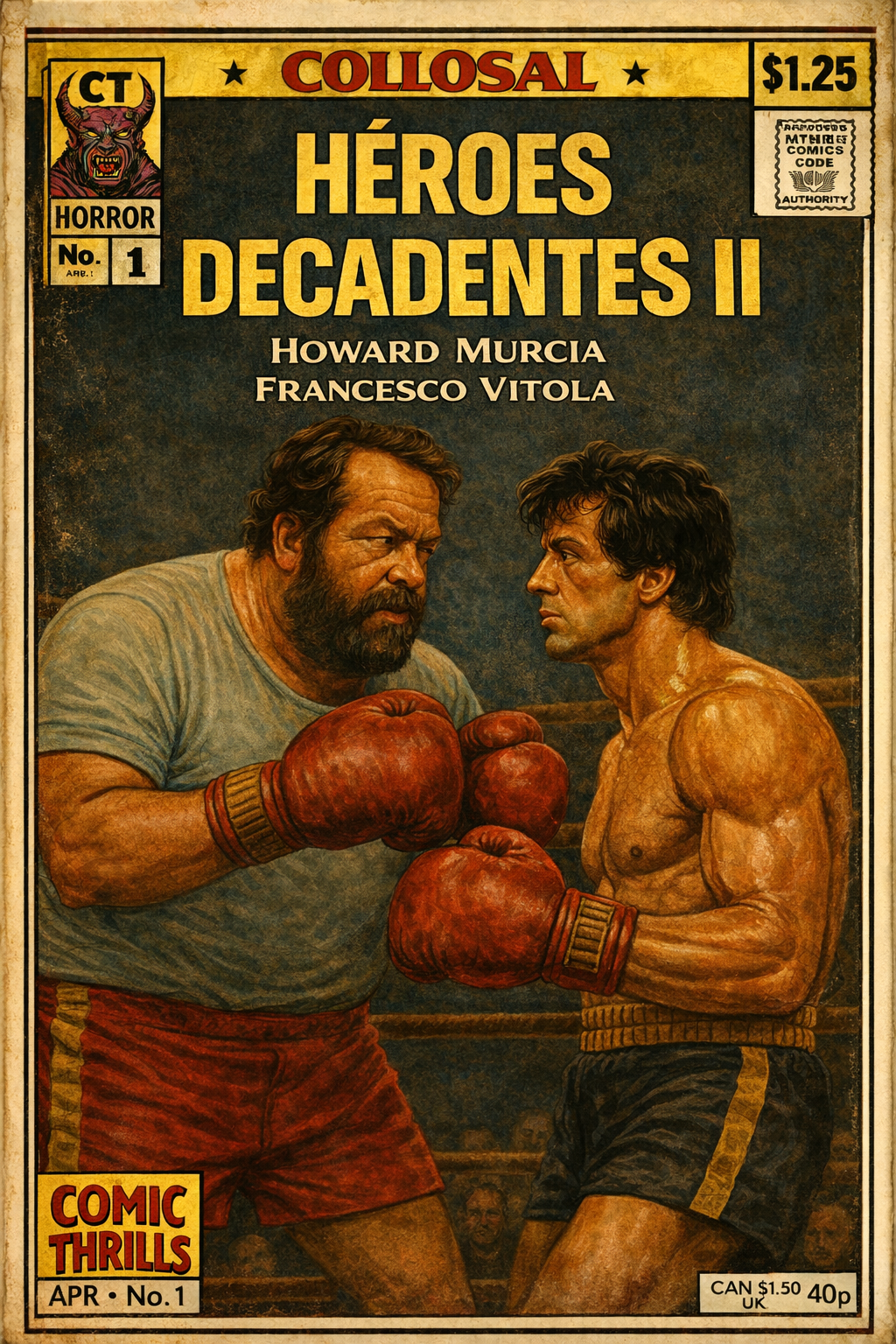
(Novela bilingüe por entregas. ESP/EN)
Por Howard Murcia y Francesco Vitola Rognini.
Ser plural como el universo.
Fernando Pessoa.
Prólogo
El lunes amaneció sin nubes. Eso fue lo primero que notó Aurelio antes de subir al árbol: un cielo demasiado limpio, sin nubes. Tomó el machete. Revisó dos veces el nudo de la cuerda de seguridad.
El árbol era un almendro viejo que llevaba años rastrillando sus ramas torcidas contra el muro del fondo. Además, estaba plagado de comején. Las termitas habían hecho metástasis, por lo que además de la poda era necesario aplicar gasolina en las partes invadidas por los insectos.
Aurelio subió despacio. A los cincuenta y seis años no había otro modo de hacerlo. Ponía el pie, buscaba la rama, desplazaba el peso. Llegó a unos ocho metros de altura. Desde ahí la vista cambiaba: los techos de las casas vecinas, una piscina de agua verdosa, una antena oxidada, el cadáver de una paloma disecada por el sol, en el tejado vecino. El viento olía distinto también, olía a libertad, a monte.
Empezó por las ramas secundarias. Una a una dejó caer las tres ramas. Abajo, su ayudante, iba picando y apilándolas. Se desplazó hacia el otro extremo del árbol, donde había que pisar con cuidado por el comején. Encontró la rama que frotaba el muro como uñas largas en un espejo. Calculó el corte. Ajustó la posición del cuerpo.
Lo que pasó después ocurrió en menos de dos segundos. La rama no cayó, sino que hizo un movimiento pendular y lo golpeó en el pecho, arrojándolo fuera de su zona segura. La cuerda se quebró con un sonoro chasquido de latigazo. Néstor cayó rebotando de una rama a otra, y finalmente, contra el suelo del jardín.
Desde abajo, tumbado de espaldas, Néstor contempló el cielo sin nubes, seguía ahí, inmutable, sin la menor consideración por lo que acababa de ocurrir. Su ayudante, metido en su campo visual, le hablaba, pero la voz le llegaba en sordina. No sentía dolor, el cuerpo aún no lo registraba. Intentó mover la mano derecha, pero no pudo. Intentó llamar, pero no escuchó su propia voz. Entonces una sensación, somnolencia quizás, empezó a nublar los bordes del campo visual y fue cerrándose despacio hacia el centro. Y en medio de aquella oscuridad, un túnel de luz por el que se acercaba alguien en sandalias, con toga blanca y una barba larguísima. Pero no eran sandalias normales. Tenían algo en los costados —unos apéndices pequeños, como alas de pollo BBQ—. Las sandalias levitaban sobre el suelo, pero parecían caminar silenciosamente sobre una pista invisible. El hombre que llevaba las sandalias era delgado, de mediana estatura, con una túnica corta que en otro contexto habría parecido un disfraz. Llevaba en la mano izquierda una tablilla de arcilla. En la derecha, un punzón. Tenía expresión de funcionario indiferente a todo.
—¿Estoy muerto? —preguntó Néstor.
El hombre consultó la tablilla.
—Esa pregunta de naturaleza administrativa está fuera de mi jurisdicción.
—¿Y qué jurisdicción tiene usted?
—Traslados. —Hizo una pausa. Anotó algo con el punzón.— Soy el responsable de llevarlo del punto A al punto B. Lo que ocurra en el punto B no depende de mí.
—¿Cuál es el punto B?
—No se proporciona esa información de antemano. Forma parte del procedimiento.
Néstor miró alrededor. El espacio era oscuro en todas las direcciones, sin horizonte, sin referencia de distancia.
—¿Y si no quiero ir?
El hombre lo miró por primera vez con algo parecido al interés.
—En mis años de servicio —dijo— nadie me había hecho esa pregunta.
—¿Y cuál sería la respuesta?
—Aquí no existe voluntad ni libre albedrío.
Hizo un gesto burocrático con la mano libre, y el espacio-tiempo empezó a cambiar. Nestor sintió que le movían el piso.
—¿Cómo se llama usted? —alcanzó a preguntar al hombre que iba varios pasos adelante.
—Hermes —dijo, sin voltearse—.
DECADENT HEROES II: THE NOVEL
(Serialized Bilingual novel)
By Howard Murcia and Francesco Vitola Rognini.
To be plural like the universe.
Fernando Pessoa.
Prologue
Monday arrived without clouds. That was the first thing Néstor noticed before climbing the tree: a sky too clean, without a single cloud. He picked up the machete. He checked the safety rope knot twice.
The tree was an old almond that had spent years dragging its twisted branches against the back wall. It was also riddled with termites. The infestation had metastasized, so in addition to the pruning it would be necessary to treat the affected sections with gasoline. Néstor climbed slowly. At fifty-six there was no other way to do it. He set his foot, found the branch, shifted his weight. He reached about eight meters up. From there the view changed: the rooftops of neighboring houses, a pool of greenish water, a rusted antenna, the carcass of a pigeon mummified by the sun on the roof next door. The wind smelled different too — it smelled of open country, of freedom.
He started with the secondary branches. One by one he let the three branches fall. Below, his assistant went about chopping them up and stacking them. He moved toward the far end of the tree, where the termite damage made every step uncertain. He found the branch that scraped the wall like long fingernails on glass. He calculated the cut. He adjusted his position.
What happened next took less than two seconds. The branch didn’t fall — it swung like a pendulum and caught him in the chest, throwing him clear of his safe zone. The rope snapped with a crack like a whip. Néstor fell, bouncing from branch to branch, and finally hit the garden floor.
From below, flat on his back, Néstor looked up at the cloudless sky. It was still there, unchanged, without the slightest regard for what had just happened. His assistant stood in his field of vision, talking, but the voice reached him muffled, as if from underwater. He felt no pain — his body hadn’t registered it yet. He tried to move his right hand but couldn’t. He tried to call out but heard nothing come from his own mouth. Then a kind of drowsiness began to blur the edges of his visual field, closing in slowly toward the center. And in the middle of that darkness, a tunnel of light, and coming through it someone in sandals, in a white toga, with an enormously long beard. But they weren’t ordinary sandals. They had something on the sides — small appendages, like the wings of a BBQ chicken. The sandals hovered just above the ground yet seemed to walk silently along an invisible track. The man wearing them was lean, of medium height, in a short tunic that in any other context would have looked like a costume. In his left hand he carried a clay tablet. In his right, a stylus. His expression was that of a functionary indifferent to everything.
—Am I dead? — Néstor asked.
The man consulted the tablet.
—That question is administrative in nature and falls outside my jurisdiction.
—And what jurisdiction do you have?
—Transfers. — He paused. He wrote something with the stylus. — I am responsible for taking you from point A to point B. What happens at point B is not my concern.
—Which is point B?
—That information is not provided in advance. It’s part of the procedure.
Néstor looked around. The space was dark in every direction, without horizon, without any reference to distance.
—And if I don’t want to go?
The man looked at him for the first time with something resembling interest.
—In my years of service — he said — no one has ever asked me that question.
—And what would the answer be?
—There is no will here. No free will of any kind.
He made a small bureaucratic gesture with his free hand, and space-time began to shift. Néstor felt the ground move under him.
—What is your name? — he managed to ask the man who was already several steps ahead.
—Hermes — he said, without turning around.
Acerca del autor


1 pensó en "Héroes decadentes II: la novela"
Los comentarios están cerrados.